

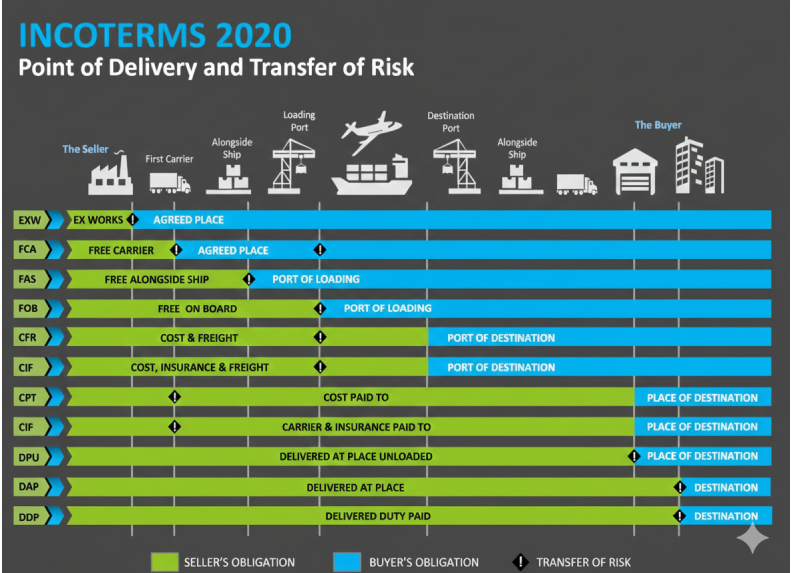
Incoterms define clear rules for shipping, outlining who handles costs, transport, and risk at every stage of the journey.
Ex Works (EXW)
Under EXW, the seller makes the goods available at their premises — usually a factory, warehouse, or office. Their responsibility ends once the goods are set aside and ready for pickup. They do not need to load the goods onto a vehicle or arrange any transportation. From the moment the seller notifies the buyer that the goods are ready, the risk shifts to the buyer, even if the goods are still physically inside the seller’s building. All further handling, transport, export paperwork, and costs must be taken care of by the buyer. EXW is therefore one of the most seller-friendly terms.
Free Carrier (FCA)
With FCA, the seller delivers the goods either:
- Loaded onto the buyer’s collecting truck at the seller’s premises, or
- Delivered (but not unloaded) at a location chosen by the buyer, such as a freight forwarder’s warehouse or terminal.
The seller also completes export clearance. Import formalities fall to the buyer. Risk passes to the buyer only when delivery is completed at the agreed point. FCA is often used for land-based shipments, especially within regions like Europe or Central Asia where the same vehicle may carry the goods to their final destination.
Carriage Paid To (CPT)
In CPT, the seller hands over the goods to a carrier they select and also pays for the transport to the destination agreed in the contract. However, risk transfers to the buyer as soon as the goods are delivered to the first carrier, not at the final destination. The seller manages export clearance, while the buyer handles import procedures. CPT is suitable for situations where the seller arranges the freight but the main portion of risk passes early in the process.
Carriage and Insurance Paid To (CIP)
CIP is similar to CPT, but with one additional obligation — the seller must also arrange insurance for the buyer’s benefit up to the named destination. Even though the seller pays for transport and insurance, the risk moves to the buyer once the goods have been handed to the first carrier. CIP can be used with any mode of transport. Buyers may choose extra insurance if they want broader coverage beyond what the seller arranged.
Delivered at Place (DAP)
DAP means the seller transports the goods to a location chosen by the buyer — commonly the buyer’s facility or warehouse. The goods are considered delivered when they are ready for unloading. The seller handles export customs, while import duties and clearance are the buyer’s responsibility. Risk transfers to the buyer once the goods arrive at the designated place. DAP works well for long-distance shipments but may require careful planning when multiple transport modes are involved.
Delivered at Place Unloaded (DPU)
DPU requires the seller to deliver the goods unloaded at a place agreed with the buyer. This could be a terminal, container yard, warehouse, or even the buyer’s premises. DPU is the only Incoterm that makes the seller responsible for unloading the goods at destination. The seller completes export clearance; the buyer handles import procedures. DPU replaced the old DAT rule, expanding delivery options beyond terminals.
Delivery Duty Paid (DDP)
DDP places the maximum obligation on the seller. The seller arranges transportation all the way to the final destination, pays for freight, export and import customs, duties, and taxes. The buyer only needs to unload the goods. DDP can be applied to road, air, sea, or multimodal transport. Because the seller handles import clearance, DDP often requires knowledge of destination-country regulations and taxes.
Free Alongside Ship (FAS)
FAS is mainly used for specialized cargo, such as heavy machinery. The seller delivers the goods alongside the vessel at the port of shipment — meaning the goods are placed next to the ship but not loaded onto it. The buyer is responsible for loading the goods and arranging ocean freight. Risk transfers once the goods are positioned next to the vessel. Export clearance is the seller’s responsibility; import procedures belong to the buyer.
Cost and Freight (CFR)
Under CFR, the seller loads the goods onto the vessel and pays for transport to the agreed destination port. However, risk transfers to the buyer once the goods are on board, not when they arrive at destination. Export clearance is handled by the seller, while the buyer is responsible for import customs. The bill of lading typically shows “freight prepaid” because the seller pays the ocean freight.
Cost, Insurance and Freight (CIF)
CIF works exactly like CFR but adds the requirement that the seller must also obtain marine insurance covering the buyer’s risk during transit. The insurance is usually a policy or certificate issued under the seller’s marine insurance plan. Risk still transfers once the goods are on board the vessel, even though the seller pays for freight and insurance up to the destination port. CIF is commonly used for sea shipments of general cargo.
Have a question or need a quote?
Get in touch with Trisea Container Lines—your reliable partner in global trade. We are ready to assist you 24/7